

Scientific conferences are organized every year. The submitted papers are published following a review process (open access).
There are also other events to promote the exchange between science, education policy and school practice.
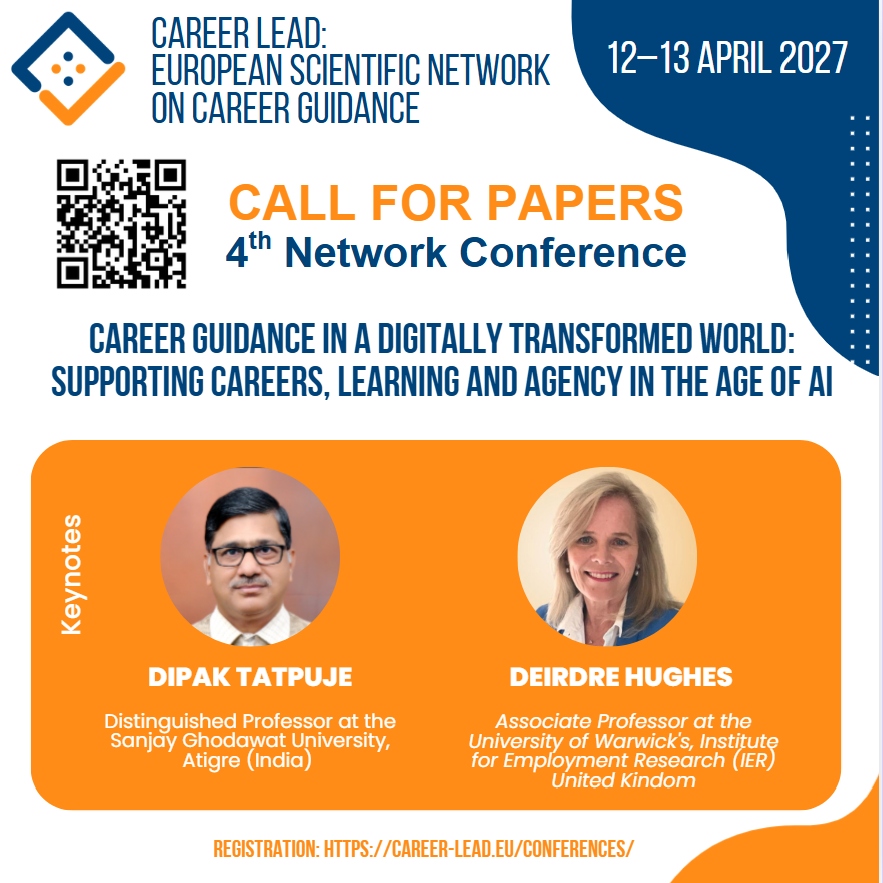
Career Guidance in a Digitally Transformed World: Supporting Careers, Learning and Agency in the Age of AI
Thematic Focal Points
- Digital Transformation and Labour Market Information
- Digital Learning and Experiential Spaces (Virtual Reality, Augmented Reality, Immersive Tech)
- Artificial Intelligence in Career Guidance (Generative AI, Chatbots, Algorithmic Matching)
- Professionalism and Pedagogical Responsibility
- Participation, Diversity, Inclusion and Digital Inequality
- Ethics, Data Protection and Regulation
- Impact, Quality and Transfer
.
Keynotes
- Dipak Tatpuje (Distinguished Professor at Sanjay Ghodawat University, Atigre, India)
- Deirdre Hughes (Associate Professor at University of Warwick, Institute for Employment Research (IER), United Kingdom)
Submit your abstract at cleg.oapublishing.ch under SUBMISSIONS.
Submission deadline: 8 January 2027
Call for Papers
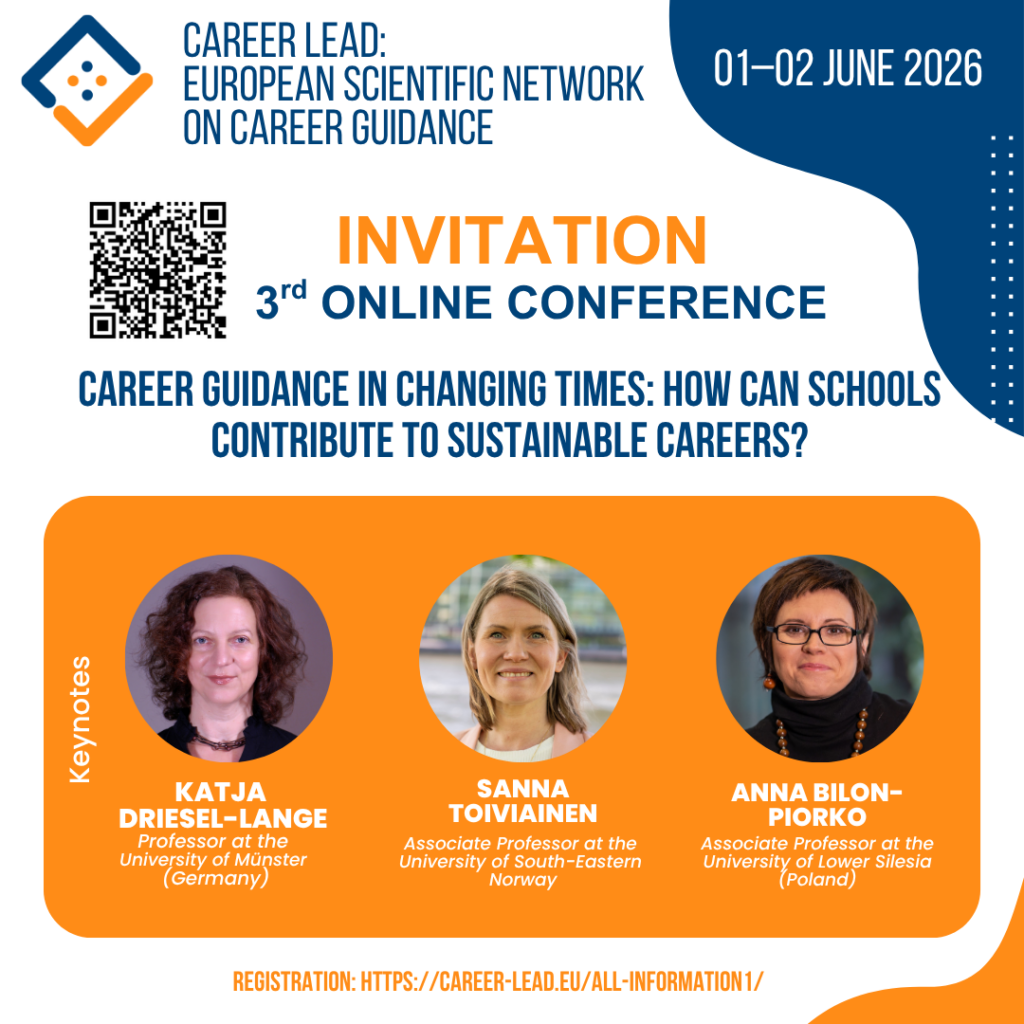
Career Guidance in Changing Times: How Can Schools Contribute to Sustainable Careers?
Online-Conference on 01st – 02nd June 2026

In an increasingly dynamic labour market and rapidly changing society, non-linear career paths are becoming the norm rather than the exception. This raises an important question: how can we prepare young people for these paths, and what is the role of the school in cooperation with parents, educational administration, the social community or the world of work?
We invite submissions that investigate innovative, theoretically and empirically solid approaches to prepare young people for this transitional phase as well as support them during this process within school settings. Submissions can address guidance and support systems, curricula and school activities, or individual learning and development within a social context. We are particularly interested in contributions that enhance career learning for students, prepare teachers to coach and guide their pupils, design and assess school-based interventions, and critically examine the role of career guidance services in collaboration with schools..
Career Guidance in Changing Times: How Can Schools Contribute to Sustainable Careers?

Keynote 1
Keynote 2
Thematic Focal Points
- How can schools contribute to sustainable careers?
- How can the transfer between career guidance science and practice be designed?
- What role do teachers play as key actors in career education and guidance?
- How can parental support be effectively synchronized with school career guidance?
- Which diagnostic tools and assessments are effective for diverse student populations?
.
Keynotes
- Katja Driesel-Lange (University of Münster): Supporting (primary) schools in developing concepts of individualized career guidance in times of societal challenges
- Sanna Toiviainen (University of South-Eastern Norway) & Anna Bilon-Piórko (University of Lower Silesia): Career learning and education for young people for response-able sustainable development
Early Career Researchers Forum
“Meet the Prof & Meet the Peer” networking session on Day 2 at 15:30
Call for Papers
Full Conference Program
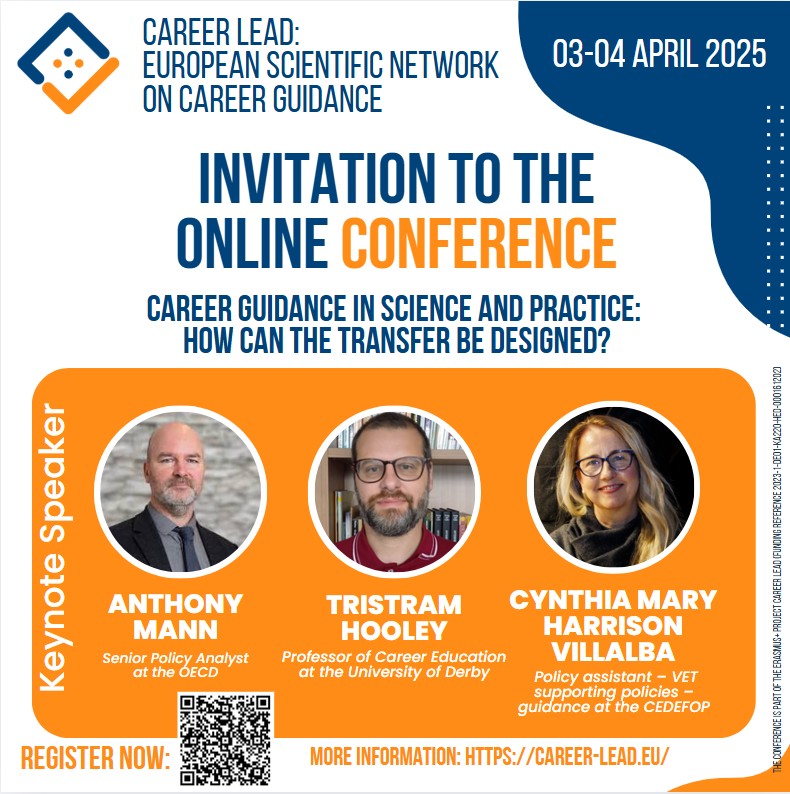
Career Guidance in Science and Practice: How can the Transfer be designed? + Meet the Prof/Peer

The conference focused on how career guidance can be developed in practice and science through cooperation between research institutes, schools and other educational institutions, educational administration and policy. Participation was free.
Keynote 1
Keynote 2
Keynote 3
Target Groups
The conference addresses European and international
- Stakeholders from education administration and education policy
- Researchers who deal with Career Guidance in school contexts
- Stakeholders from educational practice who are involved in the implementation of Career Guidance in schools, for example teachers, social pedagogues, head teachers and careers advisors
Keynotes
- Tristram Hooley, Professor of Career Education at the University of Derby:
Leading good career education and guidance in schools - Anthony Mann, Senior Policy Analyst at the OECD:
Teenage career development: what can we learn from PISA 2022 - Cynthia Mary Harrison Villalba, Policy assistant – VET supporting policies – guidance at the CEDEFOP:
Why research and policy need to be connected to develop quality guidance systems
Thematic Focal Points
The topics of the conference will focus in particular on the following questions:
- How can scientific findings guide action in schools, e.g. through guidelines such as the Gatsby Benchmarks?
- Which institutional framework conditions promote or hinder the transfer between science and practice? What contribution can education policy and administration make to improving the transfer of practice?
- What role do networks between actors from science, educational practice and educational administration play?
- Which research approaches are suitable for promoting the transfer of practice and to what extent?
- How can educational practitioners be effectively involved in research?
- What role do the competences of the actors involved (especially teachers and careers advisors) play in school practice and how can these competences be improved?
References to the thematic working groups of Career Lead – Digitalisation, Heterogeneity, Sustainable development – are desired.
In addition to contributions from a theoretical-conceptual or empirical perspective, the presentation of projects that focus on practice transfer is also welcome.
Extended Deadline for Abstracts: 27.01.2025
Career Guidance in Schools under European and International Perspectives:
Online-Conference on 27th/28th June 2024
The conference was aimed at European researchers (but was also open to researchers from other parts of the world) who are working on topics related to career guidance in schools. The conference served as a forum for exchanging research papers, identifying common research aspirations and networking among participants.
A separate slot was created for young researchers before the official start of the conference.
Keynote

Thematic focus
The topics of the conference will focus in particular on the following key areas from a theoretical-conceptual or empirical perspective:
- How can Career Guidance in general education schools prepare students to successfully shape their career biographies? What competences do students, teachers and other educational staff need to successfully shape their careers and lives?
- How can the European labour and education area be taken into account in Career Guidance?
- How can students be specifically supported against the background of diversity and inclusion? What role does teaching play? What roles do counselling, diagnostics and extracurricular learning venues play?
- What influence does digitalisation have on post-school transitions and careers? How can digital tools support Career Guidance?
- What impact does the topic of sustainability have on the world of work? How can young people be sensitised to and interested in sustainability-oriented aspects in their later working life?
- What requirements arise for education systems (e.g. legal framework conditions for extracurricular cooperation), schools (e.g. pedagogical staff, school organisation) and their cooperation partners? How can school development and transition networks be promoted?
Organisation of the conference
The conference will be organised online using Zoom and other tools. The official language of the conference is English.
Participation in the conference is free of charge.
Submission of papers
We invite you to actively contribute to the content of the conference. The contributions can also be published in the conference proceedings (open access publication).
Agenda of the Scientific Conference
Book of Abstracts
Submission of contributions